
Most service providers we talk to have already decided conversation intelligence matters. The open question is whether to build it. Getting a transcript and a summary is the easy part now. Everything after that, matching a call to the right customer and location, tuning alerts so a manager actually acts on them, passing a security review for a product that holds the content of every call, is roughly a year of work before a customer sees anything.
We faced the same choice with the iotum Communicator. Here’s what we wanted, why we didn’t build it ourselves, and what it means for providers who resell Communicator under their own brand.
The problem: the person answering wasn’t on the last call
Your customers’ customers live on the phone. When someone calls back, the person who picks up often wasn’t on the earlier conversation. The caller repeats themselves. The CRM is supposed to fill the gap, but CRMs depend on someone typing notes in, and on a busy day that doesn’t happen.
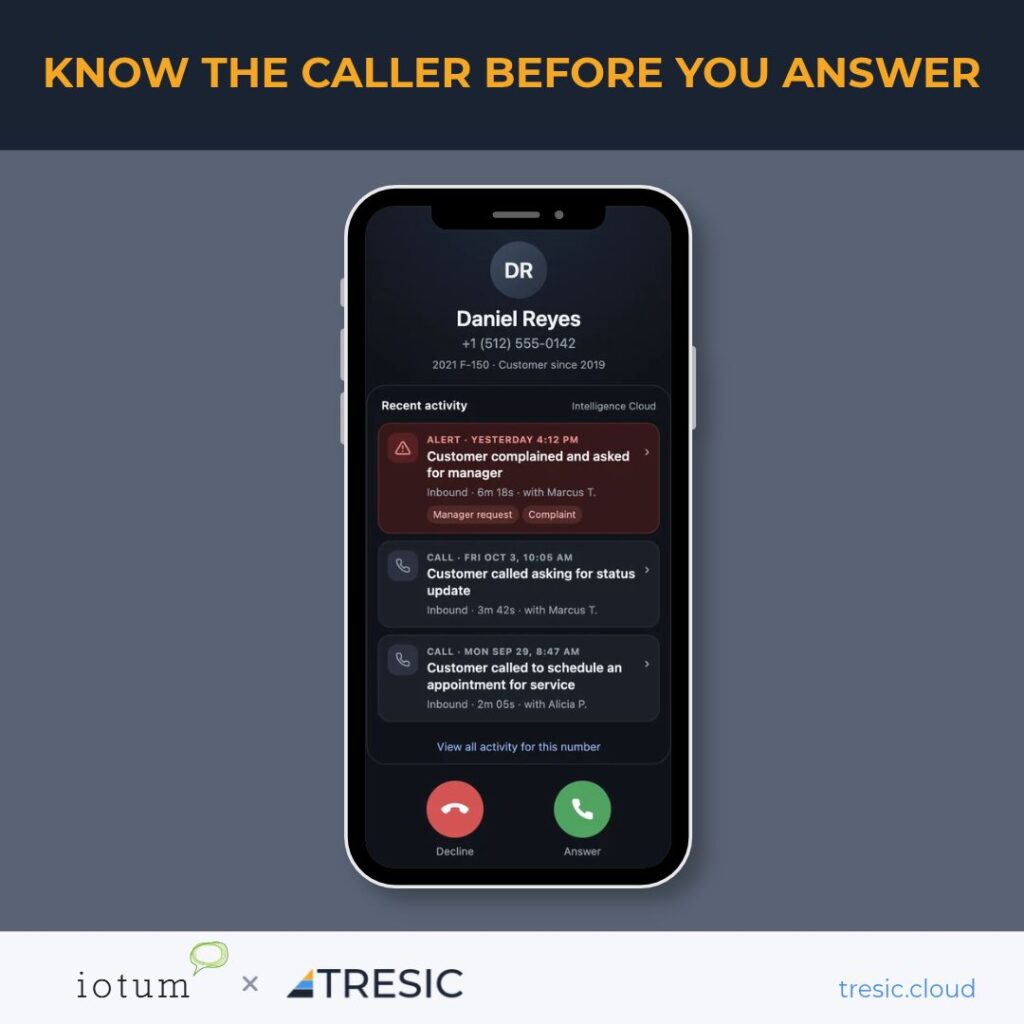
We wanted Communicator to show who’s calling and what happened last time — before anyone picks up.
How it works with Tresic Intelligence Cloud
Instead of building a conversation intelligence engine, Communicator asks Tresic’s Intelligence Cloud for two things, by phone number, as the call rings:
-
- Open alerts for that caller.
-
- Recent call history
The newest alert appears highlighted at the top of the ring screen, followed by recent calls with one-line summaries. Select a call to see the full summary, any open task, and the transcript. The same history shows up on outbound calls.
Intelligence Cloud does the heavy lifting behind that. It summarizes every call, pulls out key points and commitments, and sends an alert within minutes of hang-up if a call needs attention. If a customer asks for a manager, it creates a call-back task with an owner and a due time.
The history comes from the calls themselves, so nobody types anything into a CRM. We don’t store recordings or summarize calls on our side. And a provider can set up the integration in an afternoon.
“Nobody has to change how they work,” says Jason Martin, CEO of iotum.
Why plug in rather than build
Tresic’s engine has already been tuned on real calls. It’s built on vCon, an open IETF-track standard for conversation data, and it’s sold only through channel partners, who resell it under their own brand and pricing , the same model Communicator follows.
That means providers skip the year of plumbing and spend their time on the part their customers will actually notice: the experience.
The ring screen is just the first idea
The same lookup can do more than populate a ring screen:
-
- Brief whoever picks up a transferred call, so the customer isn’t asked to start over.
-
- Open a ticket in a help desk before the customer finishes explaining.
-
- Prep an outbound callback with the commitments made on the last call.
Communicator turns any PBX into a branded UCaaS platform. Pairing it with Intelligence Cloud adds AI assistance on top, without asking anyone to learn a new workflow.
See it at NetSapiens UGM
Both teams will be at NetSapiens UGM 2026 in Austin, October 26–29 — iotum at table 51, Tresic at booth 49. Stop by and tell us what you’d build with it.
Can’t make it to Austin? Learn more at iotum.com/tresic